
Updated August 13, 2026. Educational information only — not legal advice. This area is moving weekly; verify current law before acting.
The short version
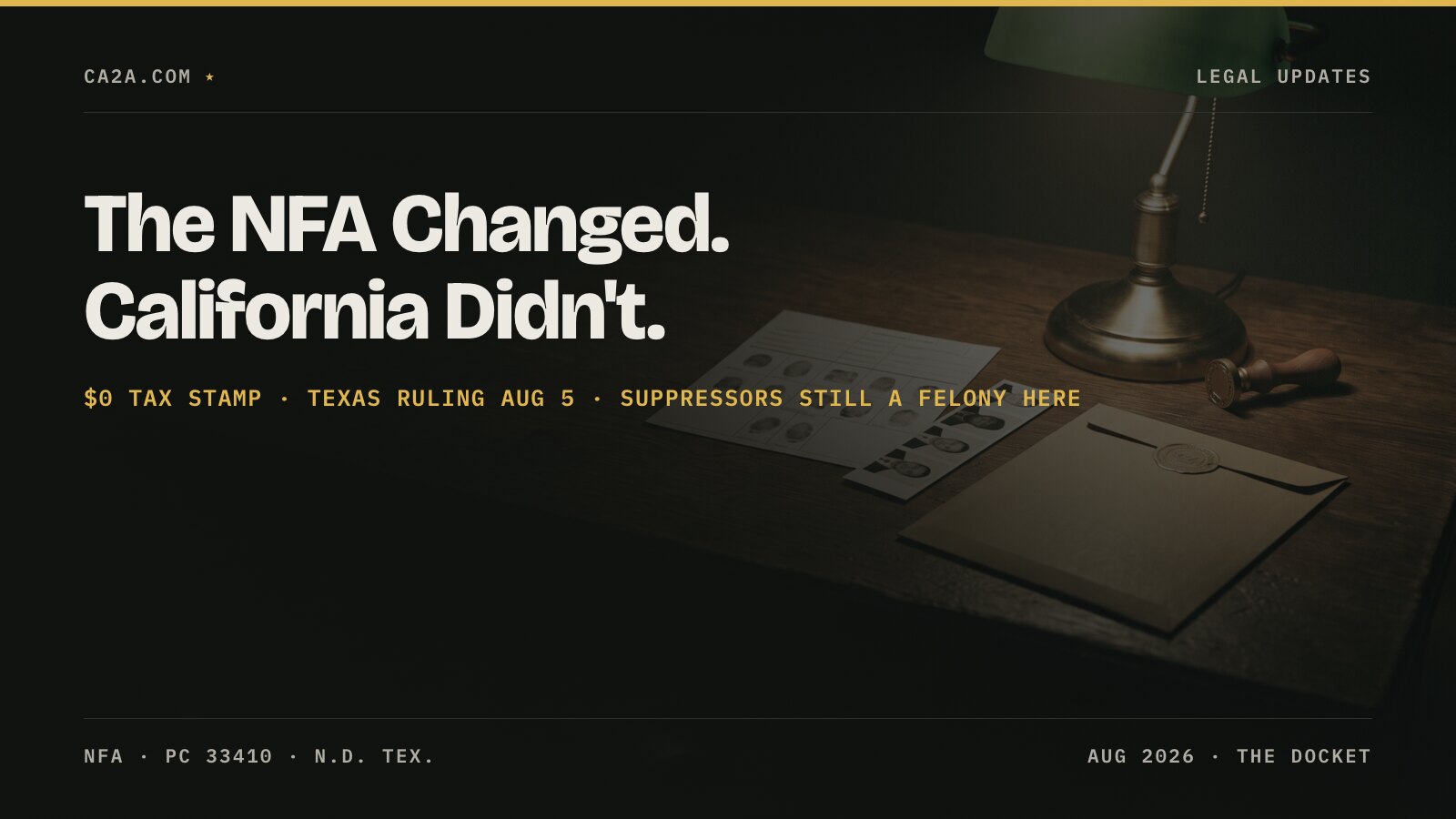
Two things happened to the National Firearms Act in 2026, and both are genuinely historic. First, the $200 tax stamp went to zero for suppressors, short-barreled rifles, short-barreled shotguns, and AOWs — effective January 1, 2026, courtesy of the reconciliation bill passed in 2025. Second, on August 5, 2026, a federal judge in the Northern District of Texas held that the NFA’s registration requirements for those same items are unconstitutional, reasoning that once Congress zeroed the tax, the taxing-power foundation the NFA has rested on since 1934 went with it.
That is the biggest structural challenge federal machine-gun-era gun law has ever faced. And if you live in California, here is the sentence that matters most: a suppressor is still a felony to possess in this state, and nothing above changes that.
What actually changed federally
The tax. Suppressors, SBRs, SBSs, and AOWs now carry a $0 transfer and making tax. Machine guns and destructive devices still carry the $200. The forms themselves (ATF Forms 1, 4, and 5) are being revised to strip out the payment sections.
Not the process. This is where most of the internet gets it wrong. Zeroing the tax did not delete the paperwork: fingerprints, passport photos, background checks, registration of the item, and the wait are all still federal requirements. Earlier drafts of the bill would have removed suppressors from the NFA entirely; the version that became law zeroed the tax instead. Expect ATF processing to slow, not speed up — a lot of people who were waiting for a free stamp all filed at once.
The court ruling, precisely. Judge James Wesley Hendrix’s August 5 decision granted a permanent injunction limited to the plaintiffs and, where applicable, their members and customers — and its effect was stayed for seven days pending appellate review. It is not a nationwide green light, and it is certainly not self-executing. Treat any “the NFA is dead” post you see as premature; this is headed to the Fifth Circuit and, plausibly, further.
What it means in California: very little, for now
Federal deregulation does not preempt state prohibition. California bans civilian suppressor possession outright under Penal Code § 33410 — a felony, independent of anything the ATF does or doesn’t require. A $0 federal tax on a thing California forbids you to own is not an opportunity; it’s a trap for the careless. The same logic applies to short-barreled rifles and shotguns, which California separately restricts.
So the practical answer for a California owner in August 2026 is unchanged:
- Suppressors: still illegal to possess. No federal change alters § 33410.
- SBRs/SBSs: still restricted under California law regardless of federal treatment.
- Buying out of state doesn’t help. Acquiring lawfully in Nevada or Arizona and bringing it home is still a California felony.
- The Texas injunction doesn’t cover you — it’s limited to the parties in that case, and it addresses federal requirements, not state bans.
The wrinkle nobody’s talking about
Here’s the genuinely interesting California problem. Penal Code § 33415(c) gives dealers an exemption allowing them to possess suppressors only if those suppressors are registered under the NFA. That exemption is written as a pointer to federal registration. If federal registration for suppressors goes away — via litigation, or via a future Congress finishing what this bill started — the pointer breaks, and the dealers who supply California law enforcement agencies may lose the very exemption that lets them do it.
It’s a drafting artifact, not a policy choice, and fixing it requires the Legislature to amend § 33415(c) to key off an ordinary federal firearms license instead. Whether Sacramento moves on a technical fix that happens to benefit the suppressor supply chain is its own question — but it’s a real, concrete thing to watch this session, and it’s the kind of detail that gets lost in national headlines.
What to watch next
The Fifth Circuit’s handling of the Texas ruling is the main event; a broader injunction or an affirmance would put enormous pressure on the registration scheme nationally. Watch also for follow-on suits in other circuits, and for whether Congress revisits delisting suppressors outright. None of that changes § 33410 — only the California Legislature or a successful state-law challenge can do that — but a federal regime in which suppressors aren’t registered items at all would put California’s ban under a very different kind of spotlight.
We’ll track it here. In the meantime: the tax stamp headlines are real, the “NFA is over” posts are not, and in California the answer to “can I get a can now?” is still no.
Sources: 2026 NFA tax stamp changes (dealer guidance) • N.D. Tex. ruling coverage, Aug. 5, 2026 • California § 33415(c) supply issue • Penal Code § 33410 overview
This article is educational content from CAGUNS Resource Hub and is not legal advice. Consult a qualified attorney about your specific situation.
What the Community Is Saying
The ruling landed on August 5 and the CAguns thread reached the same conclusion this article does, faster and with less ceremony: interesting federally, irrelevant here.
Members got the mechanism right, and that was the actual news
The most valuable post in the thread explains why the case became winnable at all: the NFA survived constitutional challenge for ninety years because it was understood as a tax. Zero out the tax and you remove the footing the whole scheme stood on. Members treated that chain of reasoning — not the headline — as the story, which is the right instinct.
The cold shower, repeated as often as necessary
The dominant reply is that this changes nothing in California, and the reason is specific rather than general pessimism: state law bans suppressors and short-barreled rifles by name, independent of their federal NFA status. The only route around it is a dangerous weapons permit that in practice goes to law enforcement and the entertainment industry. Unwinding the federal side would require a separate state lawsuit, which nobody in the thread expects soon.
They pointed at a different case instead
Rather than dwell on the Texas ruling, members redirected to litigation moving through the Ninth Circuit that turns on whether suppressors are firearms or merely firearm accessories — which they consider the question that actually decides anything for Californians. If you want to follow one case on this subject, the forum's view is that it is not the one making national headlines.
35 replies · CAguns.net
Court rules parts of the NFA are unconstitutional
Own suppressors or SBRs in a free state and moving here? Post what you did with them.
The Docket, by email
Skip the forums. Get the change and the statute behind it.
A bill passes, a case turns, the roster changes. No weekly filler, no sales. Unsubscribe in one click.
Only when something changes. Your address is never shared.