
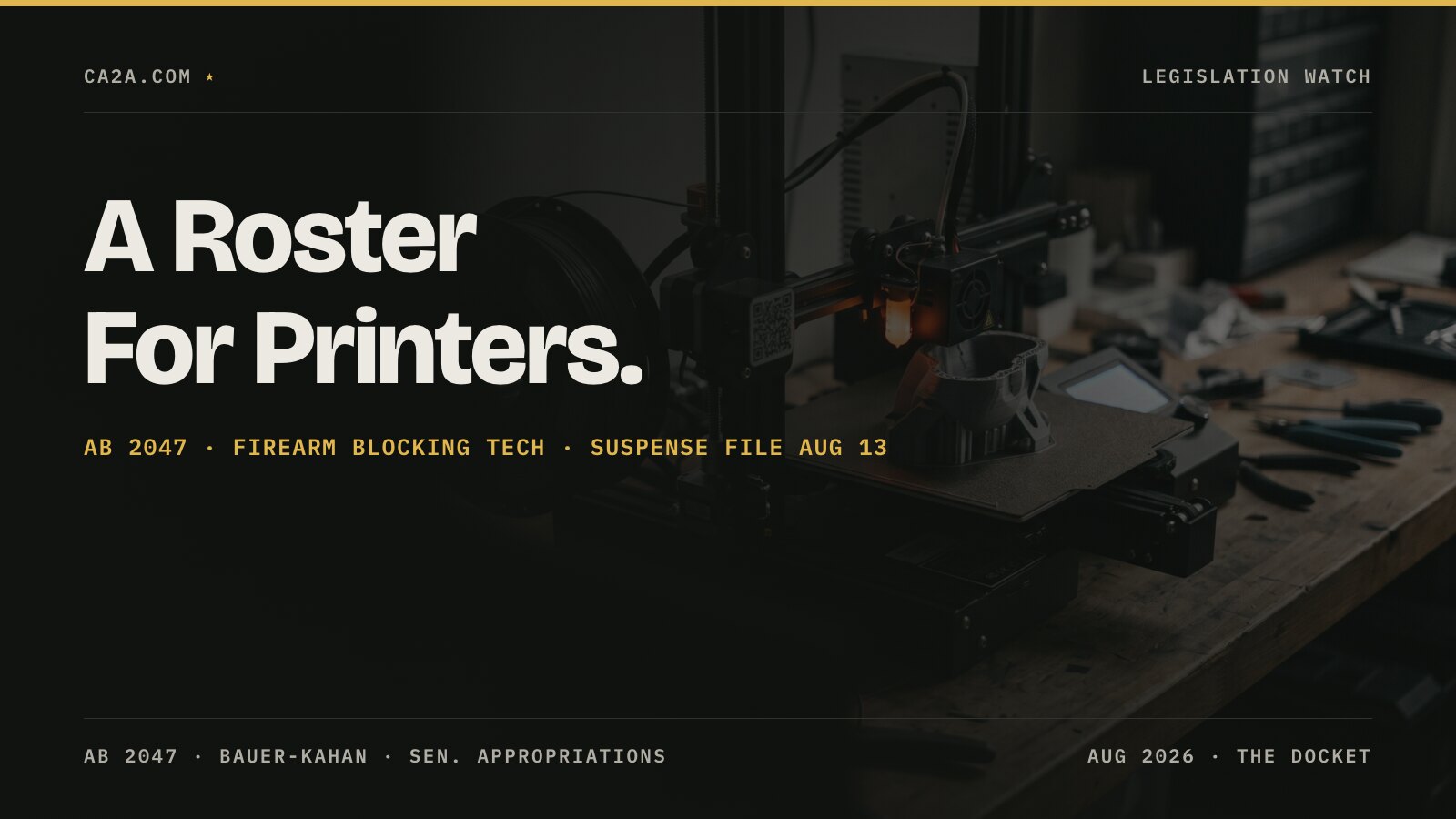

SACRAMENTO — Legislation Watch · Status: on the Senate Appropriations suspense file (placed August 3, 2026) — suspense hearing set for Thursday, August 13, 2026 · Last verified August 11, 2026 · We update this post as the bill moves.
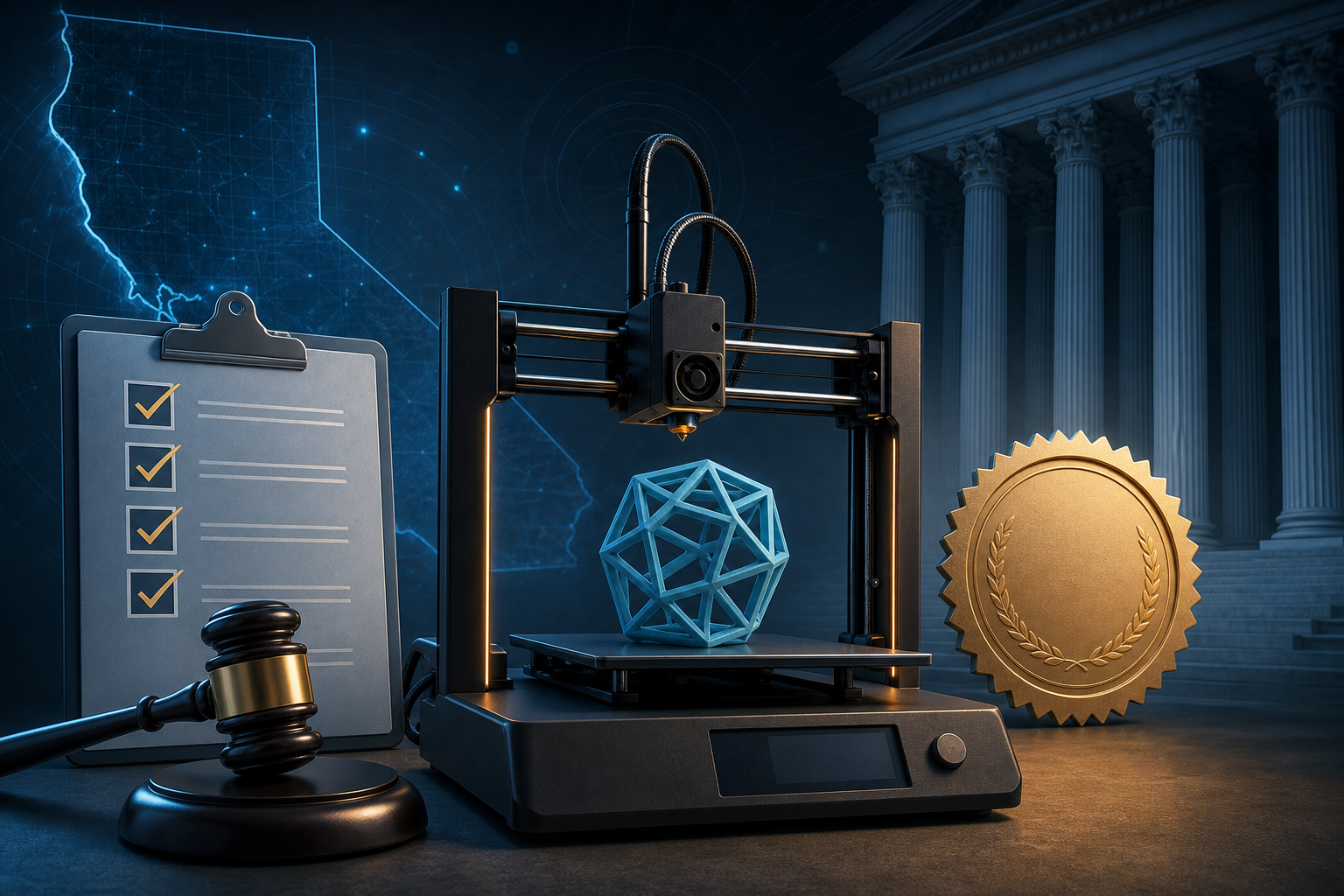
AB 2047 (Bauer-Kahan) is nominally a firearms bill, but its reach is much wider: it targets consumer 3D printing itself. The bill would require 3D printers sold or transferred in California to ship with firearm blocking technology — hardware or firmware that refuses a print job unless the file has been screened by a state-certified detection algorithm and cleared as not firearm-related. For hobbyists, small manufacturers, schools, and the maker community, that is a regulatory framework with no real precedent.
The decision point is Thursday, August 13. The Senate Appropriations Committee takes up its suspense file that day, and AB 2047 is on the list — alongside AB 1743, AB 1753, and AB 1810.
Key facts
| Author | Assemblymember Rebecca Bauer-Kahan (D) |
| What it does | Requires firearm blocking technology on 3D printers sold or transferred in California; DOJ publishes a list of compliant models; civil and criminal liability for selling non-compliant printers or circumventing the blocking technology |
| Stated purpose | Preventing 3D-printed firearms and unserialized receivers |
| Assembly | Passed May 26, 2026, 58–19 (after clearing the Assembly suspense file with 33 amendments) |
| Senate committees | Judiciary, June 23, 2026 · Public Safety, June 30, 2026 (5–1) |
| Current status | On the Senate Appropriations suspense file since August 3, 2026 — suspense hearing Thursday, August 13, 2026 |
| Opposition | 2A groups, the maker and right-to-repair communities, and EFF; open-source printing figures including the founders of RepRap and Prusa Research testified against it |
Two suspense files — don’t confuse them
AB 2047 has been on a suspense file twice, and the distinction matters for anyone tracking it. It cleared the Assembly Appropriations suspense file in May, was released with 33 amendments, and passed the Assembly floor. It is now on the Senate Appropriations suspense file, where it was placed on August 3, 2026 — a separate hold, and the one being decided on August 13.
The suspense file is where bills with a fiscal cost wait for a single up-or-down decision before the house floor deadline. Bills parked there are taken up together in a rapid hearing, and many die without a recorded vote simply by not being called. If AB 2047 comes off suspense it goes to the Senate floor; because it was amended in the Senate, an Assembly concurrence vote would follow before it could reach the Governor.
The compliance timeline
- September 1, 2028 — California DOJ publishes performance standards for firearm blueprint detection algorithms.
- March 1, 2029 — printer manufacturers must file an attestation with the state for each make and model sold in California.
- June 1, 2029 — DOJ publishes a list of compliant printer models, updated quarterly.
- December 1, 2029 — sale or transfer of non-compliant 3D printers in California becomes prohibited.
Nothing in AB 2047 changes what you may lawfully own or build today, and it does not reach printers already in your possession — the restriction is written against the sale or transfer of printers starting at the end of 2029. The bill exempts certain buyers, including licensed firearms manufacturers, law enforcement, and aerospace firms.
Why the opposition is broader than 2A
Most gun bills draw opposition from gun owners. AB 2047 also draws it from people who have never touched a firearm: the software-modification provision reads as a right-to-repair problem, and the approved-device model would put California’s 3D-printer market behind a state approval gate the way its handgun market already is. Critics describe it as banning the tool to reach the use — the same structural criticism leveled at the handgun roster now being challenged by the federal DOJ.
Two practical questions sit underneath the drafting. First, feasibility: the bill assumes a detection algorithm can reliably tell a firearm part from a bracket, a jig, or a hobby project, and the standard for that does not exist yet — DOJ is directed to write it. Second, availability: if manufacturers decline to build a California-specific printer, the effect on residents is less about enforcement than about which models can be bought in-state at all.
One practical note on the petition drives: the most-circulated petition runs through a commercial platform whose privacy disclosure permits sale of signer data. If you want to be counted, contacting the committee directly puts your position on record without the data resale.
What to watch
- August 13 — the Senate Appropriations suspense hearing. This is the audience that matters right now, not your own senator’s floor vote, which may never happen
- Amendments narrowing the software-modification provision — the likeliest concession if the bill advances
- Whether the DOJ’s roster lawsuit changes Sacramento’s appetite for another approved-device framework
Sources
- AB 2047 bill text and legislative history, 2025–2026 Regular Session (leginfo.legislature.ca.gov)
- Legislative trackers: LegiScan, BillTrack50, FastDemocracy — committee actions and vote counts
- EFF Deeplinks analysis of the Assembly-amended version, June 26, 2026
- NRA-ILA California legislative alerts, July 29 and August 10, 2026; Second Amendment Foundation Grassroots Legislative Report, August 10, 2026
Correction, August 11, 2026: an earlier version of this post said AB 2047 had been reported out of suspense and was moving through committee. That described the Assembly suspense file, which the bill cleared in May. The bill is currently on the Senate Appropriations suspense file, where it was placed on August 3, 2026.
Educational information only, not legal advice. Bill text can change at every committee stop — verify current language before acting.
The Docket, by email
Skip the forums. Get the change and the statute behind it.
A bill passes, a case turns, the roster changes. No weekly filler, no sales. Unsubscribe in one click.
Only when something changes. Your address is never shared.