
Updated August 8, 2026. Educational information only — not legal advice. Laws and court rulings change quickly; verify current law before acting.
The short version
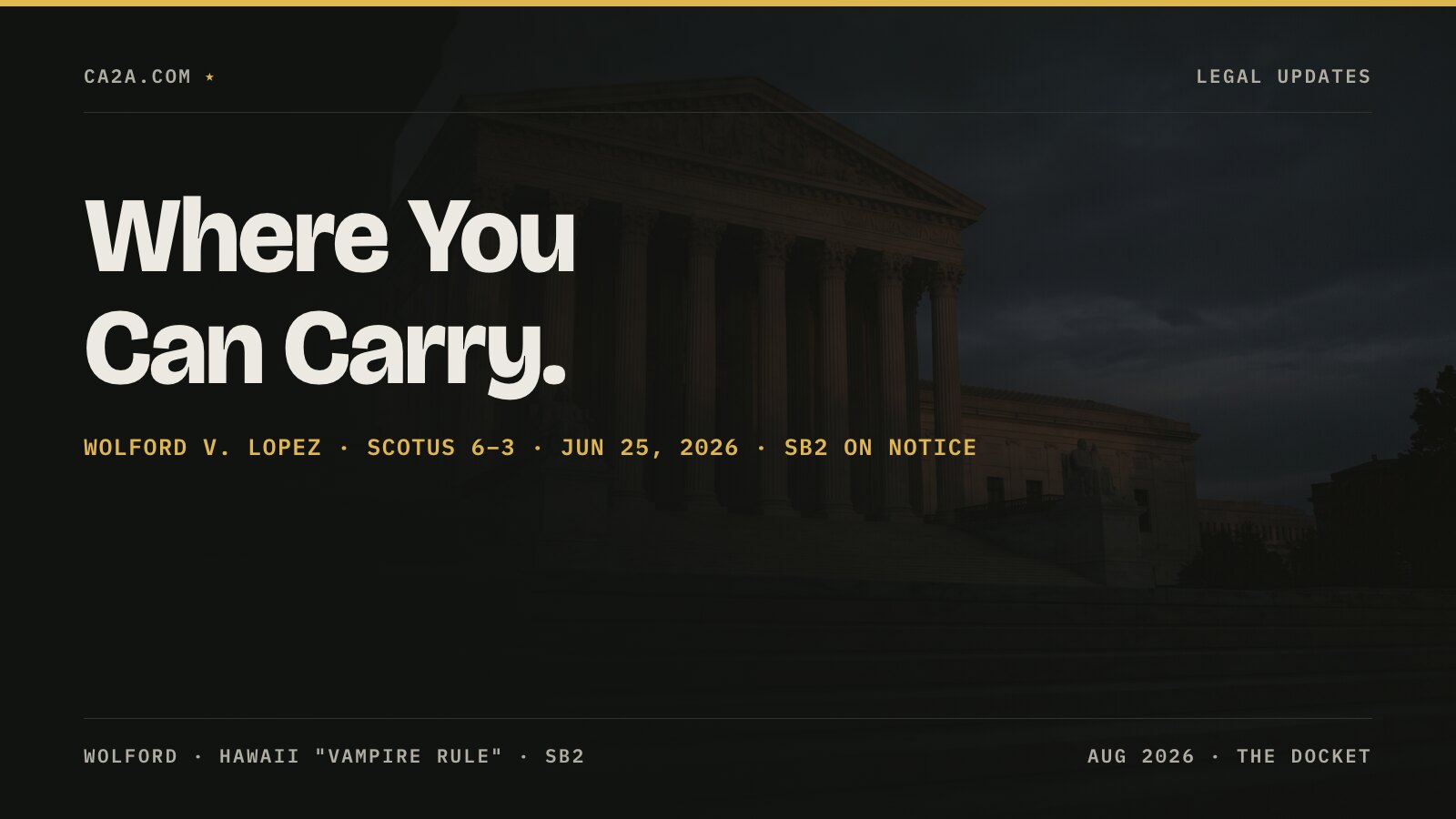
On June 25, 2026, the U.S. Supreme Court decided Wolford v. Lopez, ruling 6–3 that Hawaii’s so-called “vampire rule” — a law barring licensed concealed-carry holders from carrying on private property open to the public unless the owner affirmatively invited them in — violates the Second and Fourteenth Amendments. Justice Alito wrote the majority opinion, joined by Chief Justice Roberts and Justices Thomas, Gorsuch, Kavanaugh, and Barrett.
Why should Californians care about a Hawaii case? Because California’s SB2 contains an even stricter version of the same rule — and the dominoes have already started falling.
What the “vampire rule” was
After the Supreme Court’s 2022 Bruen decision forced “may-issue” states to start issuing carry permits, Hawaii and California responded with laws that flipped the default on private property: instead of assuming a permit holder may carry into a store or restaurant unless the owner says no, these laws assumed carry was forbidden everywhere unless the owner said yes — hence “vampire rule”: like a vampire, you couldn’t enter without an invitation. Combined with long lists of “sensitive places,” the practical effect was that a permit became nearly useless for daily life.
Hawaii at least allowed owners to give consent orally, in writing, or by posting a sign. California’s version was stricter still, recognizing consent only by posted signage.
What the Court held
The majority found that flipping the default imposed “a new and significant burden” on the right to bear arms with no historical tradition supporting it. A Ninth Circuit panel had upheld Hawaii’s rule in 2024; the Supreme Court reversed and remanded. The ruling was limited to publicly accessible private property — the Court declined to take up broader questions about sensitive-places lists in the same case. Truly private property (your home, a business closed to the public) is untouched: owners can still exclude armed patrons by making that choice themselves.
What it means for California
California’s SB2 private-property provision is functionally the twin of the law just struck down — and arguably weaker, since it gave property owners fewer ways to consent. The direct challenge to SB2, May v. Bonta (consolidated with Carralero v. Bonta), had been on hold awaiting Wolford; on July 16, 2026, it was formally reopened and returned to active litigation.
Practical guidance for CCW holders right now:
- SB2 is still on the books. Until a court formally enjoins California’s provision or the Legislature amends it, the safest course is to continue following current California law.
- Watch May v. Bonta. Given Wolford, the private-property default rule is unlikely to survive, but the timing and scope of relief are not yet settled.
- Sensitive places are a separate fight. Wolford did not resolve bans in parks, restaurants that serve alcohol, and similar locations — those SB2 provisions remain in litigation on their own track.
The bottom line
The Supreme Court has now said, clearly, that a state cannot make lawful carry disappear by declaring every shop and parking lot off-limits by default. California’s version of that rule is living on borrowed time — but it hasn’t been formally struck yet. We’ll update this article as May v. Bonta develops.
Sources: Supreme Court opinion, Wolford v. Lopez (June 25, 2026) • SCOTUSblog case page • Case background
This article is educational content from CAGUNS Resource Hub and is not legal advice. Consult a qualified attorney about your specific situation.
What the Community Is Saying
The decision came down on June 25, 2026, and the CAguns thread opened the same day. What followed is a useful record of how experienced California carriers read a Supreme Court win in real time — which is to say, cautiously.
Everyone went straight to SB2
The first move in the thread wasn't celebration, it was translation: if Hawaii's default no-carry rule for private property open to the public is unconstitutional, California's nearly identical SB2 provision is on borrowed time. Members identified May v. Bonta as the vehicle that would have to do the actual work here, rather than assuming the decision fixed anything on its own.
Does it bind California now, or do we sue again?
The sharpest practical disagreement. One position is that the holding binds lower courts the moment it issues, so the precedent is already in hand. The other is that Sacramento will find a way around it and nothing changes until a California-specific case forces the point. The consensus landing spot: the precedent is real, but nobody expects the statute to change voluntarily.
The licensing question nobody agreed on
A minority argument got real pushback: that the majority opinion walked through Hawaii's permit scheme without condemning it, and in doing so left room for states to build licensing hoops that take years to unwind. The counter was that silence on an issue nobody challenged isn't approval, and that Bruen's footnote 9 still governs shall-issue frameworks. Worth reading if you want the pessimistic case argued seriously rather than dismissed.
Discussion started the day the decision landed · CAguns.net
Carrying in California since June? Post what businesses in your area are actually doing about signage.
The Docket, by email
Skip the forums. Get the change and the statute behind it.
A bill passes, a case turns, the roster changes. No weekly filler, no sales. Unsubscribe in one click.
Only when something changes. Your address is never shared.